
Researchers, educators, and community partners are testing whether promising results can be replicated across the state
“The squeaky wheel gets the grease.”
This classic idiom is how Tracy, an early childhood educator at Archild Preschool and Child Development Center, described how interactions between teachers and children tend to occur in early childhood classrooms. Children with greater needs in a classroom setting are more likely to get the attention of their teachers.
But what about the children who don’t demand it? That question is at the center of a statewide effort that recently brought nearly 90 classrooms in Mississippi and Pulaski counties into a program designed to strengthen teacher-child interactions.
For educators, ensuring every child has opportunities to engage can be difficult in busy classrooms where needs vary widely. Understanding how those interactions shape children’s development is the goal behind the expansion of LENA GrowTM across Arkansas.
LENA Grow is a coaching-based professional development program designed to help educators strengthen interactions with children. These back-and-forth interactions between adults and children are one indicator of quality in early childhood education.
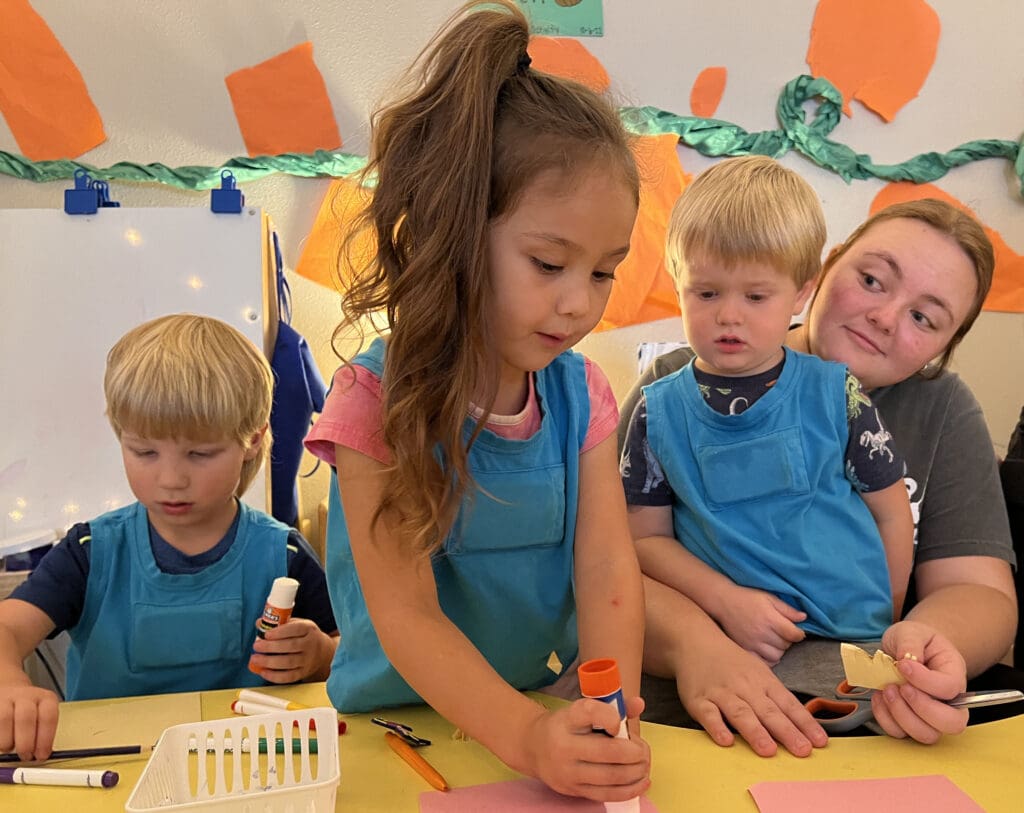
Throughout the five-week program, participating children wear talk pedometers one day each week, tucked into specially designed vests. The devices do not record what is said. Rather, they measure conversational turns, the back-and-forth exchanges that occur when a child and an adult respond to one another within five seconds. Any speech-like sounds, from babbles to words, count as a turn.
The resulting data gives educators a picture of how interactions are happening throughout the day. Teachers then meet regularly with a coach to review the information, identify patterns, and set goals for the following week.
Several of those participating classrooms were at Archild. For more than 50 years, the Little Rock-based Early Intervention Day Treatment (EIDT) program has served children with a range of developmental and intellectual needs, making it an ideal setting to explore how intentional classroom interactions can support children’s growth and development.
Melvin Dennis, supervisor of the preschool program at Archild, regularly sits in on the coaching sessions.
“LENA has encouraged our teachers to ask the children open-ended questions and increase interactions. Typically, engagement improves after observations, but LENA allows teachers to set their own goals to work toward,” Dennis said. “The goals keep them on track and make them better at engagement. It’s a reminder of the impact.”
As a strengths-based program, LENA is not designed to evaluate teachers. Instead, it gives educators data about classroom interactions and pairs them with a coach to identify opportunities for growth and set measurable goals.
“It pulls the curtain.”
Robin Jones is special projects manager at Early Care and Education Projects (ECEP), a program of the College of Education and Health Professions at the University of Arkansas. ECEP is providing strengths-based coaching to early childhood educators across the state as part of a grant from the Walton Family Foundation.
She explained that the role of a coach is to help the teacher identify strategies that help them be successful in increasing conversational turns, whether that means focusing on a student with fewer conversational turns or increasing interactions during parts of the day when engagement can drop, such as during mealtimes or when playing outdoors.
“During those five weeks, so much change happens with the children and with the teachers, both in terms of their actions in the classroom and their perception of themselves as teachers,” Jones said. “It pulls the curtain. You don’t know until you know, and all of a sudden, you see moments and patterns where you may not have realized you weren’t talking as much.”
Jones said having a strong teacher-coach relationship makes all the difference. Rather than prescribing solutions, coaches help teachers identify their own patterns and decide where they want to improve. The real shift, she said, happens when educators see something in the data that they hadn’t noticed before and begin making small adjustments in response.
“The coach is there to help facilitate the goals and what the teacher wants to happen. The teacher is the expert in the room,” Jones said. “We want them to decide what they want to work on and where they want to increase talk, whether that’s around mealtimes or for specific students who don’t have as many exchanges.
“Once that change happens as a result of coaching, those children in the classroom and in future classrooms get the long-term benefits of these quality interactions.”
Trinity, who teaches 3- and 4-year-olds at Archild, said the data revealed both strengths and opportunities for growth: She was engaging students more than she realized, while still finding room to increase conversational turns. Either way, she said, the experience has made her a better educator.
“The more you talk to them, the more you realize they talk back and understand,” she said.
“It’s a picture of a child’s day.”
Posted throughout the Archild facility are LENA’s 14 Talking Tips, which encourage families and caregivers to build conversational turns through everyday activities such as meals, reading, and play. The same principles apply in the classroom, where educators look for opportunities to encourage communication in all its forms.
Zada is a co-teacher in the Peacock classroom at Archild for 5-year-olds. She said although it can be a challenge to communicate with students who are not using words, LENA has helped her find ways to support a child’s communication in other ways.
“It is hard to get the nonverbal students to talk; sometimes they barely make noise,” Zada said. “But they are communicating, even through smiling.”
One of LENA’s tips for encouraging conversational turns with “non-talkers” is for adults to affirm all attempts to communicate by responding with a smile or a clap. This lets a child know their voice matters and keeps the interactions going. Tracy said her co-teacher Zada models this well.
“Zada is good at reaffirming what they do by saying things like, ‘Thank you for looking at me,” when they make eye contact,” she said. “LENA helps us overcome the ‘squeaky wheel’ tendency by helping us see which kids need more words compared to those we hold conversation with the most.”
Jones said one lesson ECEP has learned is that successful implementation depends on more than a single teacher or classroom.
“It’s a picture of a child’s day,” Jones said. “It’s the cook who comes in and brings the food. It’s everyone. The more you get them involved, the more successful it is.”
Jones said programs see the strongest results when administrators, teachers, and families all understand how everyday interactions support children’s development and work together to create a culture that values early talk.
Stories like Trinity’s and Zada’s are now playing out in classrooms across the state — the result of a yearslong effort to take what started as a local pilot and test it statewide.
While many early childhood educators across Arkansas are just being introduced to LENA, the program has been used in the state since 2022. Early childhood centers in Independence County were the first in the state to pilot the program through Impact Independence, a program of the Batesville Area Chamber of Commerce. Independence County is one of six Excel by Eight communities. Additionally, ECEP was implementing LENA in infant and toddler classrooms across the state through Preschool Development Grant funding.
The pilot reflects Excel by Eight’s “local models for change” approach. Following positive results in Independence County, Excel by Eight convened partners from across the state to explore whether the approach could benefit children in other communities.
Around the same time, the Arkansas Department of Education began piloting a new assessment tool for measuring quality called CLASS®. Early research suggested LENA could positively influence CLASS scores.
To better understand that relationship, Excel by Eight partnered with the University of Virginia, ECEP, LENA, and the Arkansas Department of Education’s Office of Early Childhood on a randomized controlled trial that will eventually include 400 classrooms across Arkansas.
Jessi Rice Woods, Excel by Eight’s communities director and a certified LENA coach, has been involved with LENA since its introduction in Arkansas and worked alongside local partners during the Independence County pilot. Today, she helps coordinate the many partners involved in the project, from local communities and CLASS observers to researchers and the Arkansas Department of Education Office of Early Childhood.
Early results from the Independence County pilot helped build support for expansion. Children who began the program with fewer than five conversational turns per hour increased from an average of 8.8 turns per hour to 14.5 turns per hour—a 65% increase.
“There are children in every classroom who experience a low-talk environment, which means they have fewer than five conversational turns an hour,” Rice Woods said. “Those are the kids that this program makes the most difference for.”
Arkansas is now testing whether the results seen in Independence County and other pilot sites can be replicated at scale, and the randomized controlled trial is designed to answer that question. The transition from pilot to statewide effort will take place over four cohorts during the next two years. The first cohort includes 89 classrooms across Mississippi and Pulaski counties, representing a mix of Head Start, school-based, and privately operated programs. Over time, the study will follow 400 classrooms across Arkansas to help researchers better understand how LENA influences classroom quality and teacher-child interactions.
For Rice Woods, the expansion of LENA is about more than measuring conversational turns or classroom quality. It is also an opportunity to better understand and elevate the work early childhood educators do every day.
Among Arkansas teachers who participated in LENA between 2022 and 2026, 92% reported seeing changes in children’s language development. Eighty-four percent said the experience increased their job satisfaction, and 88% reported greater confidence in their teaching abilities.
“What we’re trying to do is make sure that teachers aren’t unsung heroes anymore,” Rice Woods said. “LENA is helping raise awareness of the expertise teachers already possess and the skill it takes to manage a classroom while supporting every child’s development. I hope one outcome of this project is that we better understand what teachers experience every day and how that work supports early learning for children.”